 Outdoors Nearby
Tennis court dimensions: singles, doubles, net height and space you need
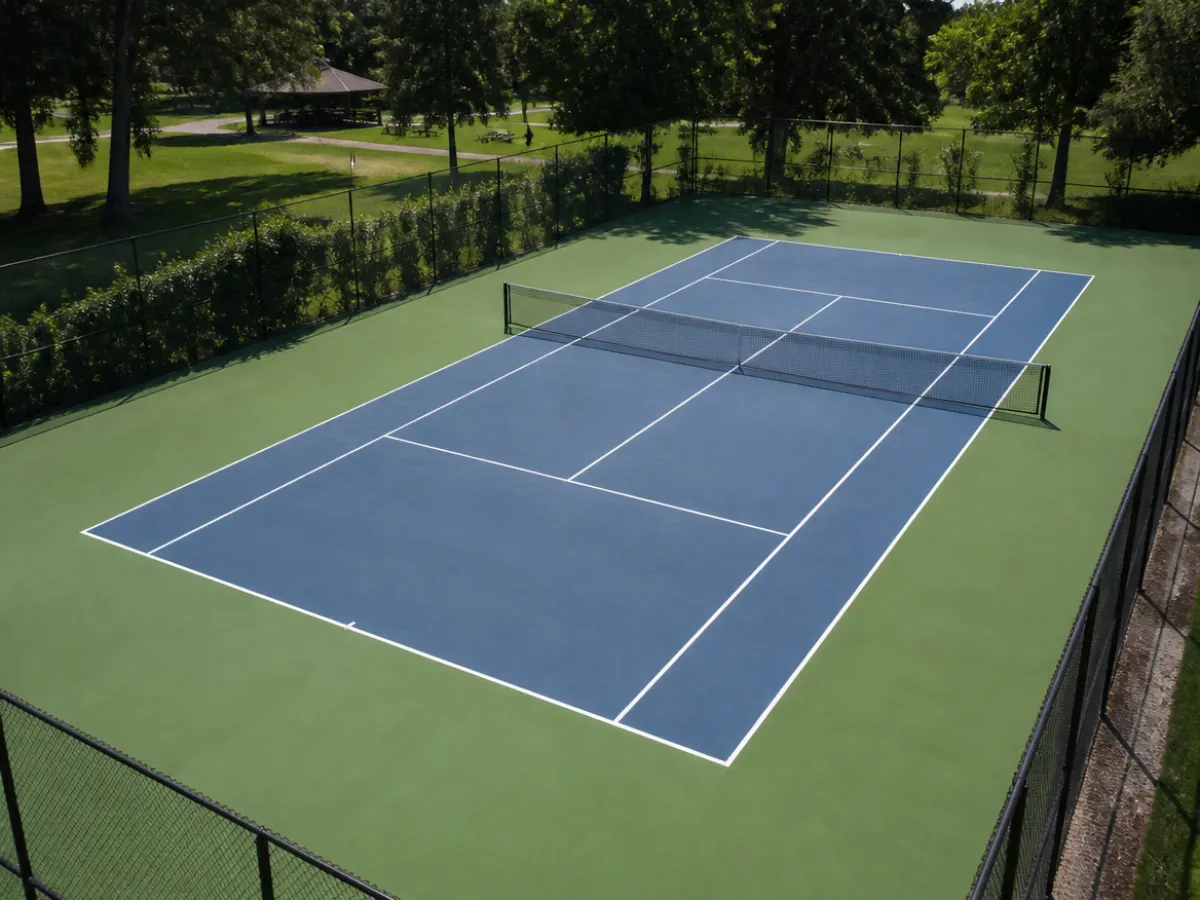
A standard tennis court is 78 feet long and 36 feet wide for doubles. The singles court is the same length but 27 feet wide. Both are painted on one court: the extra 4.5 feet on each side, called the doubles alley, is only in play for doubles. The net is 3 feet high at the center and 3.5 feet at the posts. These measurements come from Rule 1 of the ITF Rules of Tennis, which the USTA follows in the US.
We've mapped 15,253 places with public tennis courts across the US from OpenStreetMap. 15,253 of them are inside a park, and 2,168 sit in a park that also has pickleball courts.
Standard tennis court dimensions in feet and meters
| Part of the court | Feet | Meters |
|---|---|---|
| Length, baseline to baseline | 78 ft | 23.77 m |
| Width, doubles | 36 ft | 10.97 m |
| Width, singles | 27 ft | 8.23 m |
| Doubles alley, each side | 4.5 ft | 1.37 m |
| Service line to net | 21 ft | 6.40 m |
| Service line to baseline | 18 ft | 5.49 m |
| Service box | 21 × 13.5 ft | 6.40 × 4.115 m |
| Net height, center | 3 ft | 0.914 m |
| Net height, posts | 3.5 ft | 1.07 m |
| Net posts outside the doubles sideline | 3 ft | 0.914 m |
| Court area, doubles | 2,808 sq ft | 260.8 m² |
The net splits the court into two halves of 39 feet each. The service line crosses each half 21 feet from the net, and the center service line divides that area into two service boxes, each 13.5 feet wide. The remaining 18 feet between the service line and the baseline is the backcourt.
Lines
- Baseline: up to 4 inches (10 cm) wide.
- Center service line and center mark: 2 inches (5 cm) wide. The center mark is 4 inches long and sits inside the court at the middle of each baseline.
- All other lines: between 1 and 2 inches (2.5 to 5 cm) wide.
The lines are part of the court they bound. All measurements are taken to the outside of the lines, so a ball that touches any part of a line is in.
Checking a court with a tape measure
If you're laying out lines or checking an old court, measure the diagonals. On a square doubles court, corner to opposite corner is about 85 feet 11 inches. The singles diagonal is about 82 feet 6 inches. If the two diagonals match, the corners are square. Then check the net with a measuring stick at the center strap: it should read 3 feet.
Singles tennis court dimensions
For singles you play inside the inner pair of sidelines, a court of 78 by 27 feet, or 2,106 square feet. The service boxes are the same for singles and doubles. Only the alleys drop out.
Most public courts have a doubles net with posts 3 feet outside the doubles sidelines. In an official singles match on such a court, two singles sticks hold the net up 3 feet outside each singles sideline, so it stays 3.5 feet high at the edge of the singles court. Without them, the net is a little lower at the singles sidelines than the rules intend.
How much space a tennis court needs
The painted court is only part of the footprint. Players need room to run behind the baseline and wide of the sidelines. The ITF recommends these minimums:
| Level of play | Behind each baseline | Beside each sideline | Total area |
|---|---|---|---|
| Club and recreational | 18 ft (5.48 m) | 10 ft (3.05 m) | 114 × 56 ft (6,384 sq ft) |
| International | 21 ft (6.40 m) | 12 ft (3.66 m) | 120 × 60 ft (7,200 sq ft) |
The 120-by-60-foot rectangle is a common size for the fenced space around a single court. It's also the area that gets split into four pickleball courts when a park converts a tennis court.
Residential tennis court dimensions
A backyard court uses the same 78-by-36-foot lines as a public one, so the decision is about the space around it. With the ITF's recreational minimums, you need a flat area of 114 by 56 feet, about 6,400 square feet. With the international minimums, it's 120 by 60 feet, or 7,200 square feet. Keep the lines at full size even on a tight lot and cut the run-back instead, so the court plays like the public courts you'll compete on.
For a smaller lot, the USTA's 60-foot court is an option for kids and short-court play. It's 60 feet long and 21 feet wide for singles, 27 feet for doubles. The USTA asks for at least 14 feet of run-off behind the baselines and 10 feet at the sides, which gives a minimum paved area of 84 by 47 feet for one doubles court.
Before you build, check zoning setbacks, HOA rules and drainage on your lot.
Tennis court surfaces at public parks
- Hard courts: asphalt or concrete with an acrylic color coating. The US Open and the Australian Open are played on hard courts, and most city park courts are hard courts too.
- Clay: red clay like at the French Open, or green clay, often sold under the name Har-Tru. The USTA's national campus in Orlando has 32 green clay and 6 red clay courts. Clay needs regular watering, rolling and brushing, so you'll see it less often at public parks.
- Grass: the Wimbledon surface. Public grass courts are rare in the US.
The court dimensions don't change with the surface. The ball bounces higher and slower on clay and lower and faster on grass.
Pickleball lines on tennis courts
Many parks paint pickleball lines on their tennis courts in a second color. A pickleball court is 20 by 44 feet, so it fits inside the tennis doubles court with room to spare, and the tennis net at 3 feet in the center is only 2 inches higher than a pickleball net. Our pickleball court dimensions guide shows how the lines fit and how many courts a tennis court can hold.
Find public tennis courts near you
Our tennis court map lists public courts in parks across all 50 states. The states with the most mapped courts are California (1474), Illinois (1009), Texas (911) and Florida (838). Cities with many: Minneapolis (173), Chicago (131), Houston (129), Saint Paul (127), Dallas (89), Omaha (81). Looking for a different court? See our basketball court dimensions guide.
Court data from OpenStreetMap. Some park courts need a reservation or charge a fee, so check with your parks department.
Sources
- ITF Rules of Tennis 2026, Rule 1 (court, net, lines) and appendix on run-back and side space
- USTA: Standards for 60-foot tennis courts
- Sports Destination Management: USTA National Campus by the numbers (court surfaces)
- USA Pickleball: Court diagram (pickleball lines on tennis courts, orientation)