 Outdoors Nearby
Pickleball court dimensions: official size, kitchen and net height
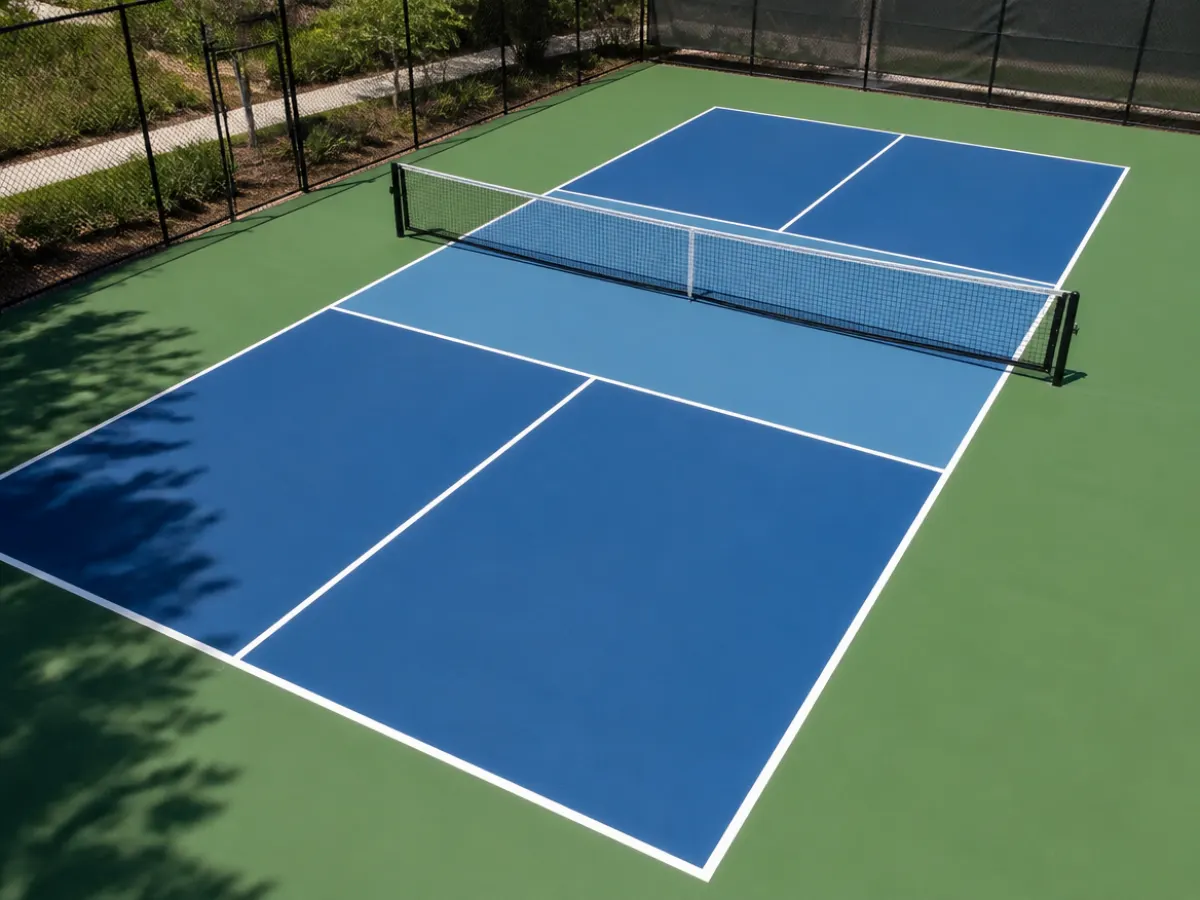
An official pickleball court measures 20 feet wide by 44 feet long. That size is the same for singles and doubles. The net crosses the middle, so each side is 22 feet deep, and the first 7 feet next to the net on each side form the non-volley zone, called the kitchen. The net is 36 inches high at the sidelines and dips to 34 inches at the center.
All numbers here come from the 2026 USA Pickleball Official Rulebook, Section 3, and USA Pickleball's guidance on building courts.
Official pickleball court dimensions in feet
| Part of the court | Official size |
|---|---|
| Court (singles and doubles) | 20 ft wide × 44 ft long (880 sq ft) |
| Each half of the court | 20 ft × 22 ft |
| Non-volley zone (kitchen), each side | 20 ft wide × 7 ft deep |
| Service court, each of four | 10 ft wide × 15 ft deep |
| Line width | 2 in, one color that contrasts with the surface |
| Net height at the sidelines | 36 in (± 0.25 in) |
| Net height at the center | 34 in (± 0.25 in) |
| Distance between net posts | 22 ft (± 1 in), inside to inside |
| Minimum playing surface | 30 ft × 60 ft (1,800 sq ft) |
| Recommended playing surface | 34 ft × 64 ft (2,176 sq ft) |
The service courts are what's left of each half once you take away the kitchen: 22 minus 7 leaves 15 feet from the kitchen line to the baseline. A centerline splits that area into a left and a right service court, each 10 feet wide. The centerline stops at the kitchen line, so the kitchen itself isn't divided.
The lines and what they mean
- Baselines: the two 20-foot lines at the ends. You serve from behind them.
- Sidelines: the two 44-foot lines along the sides.
- Non-volley zone lines: 7 feet from the net on each side. The line is part of the kitchen.
- Centerlines: run from the kitchen line to the baseline and split the service courts.
A ball that lands on any line is in, except a serve that lands on the kitchen line. Our pickleball rules guide explains the serve and kitchen rules in detail.
Net and posts
The net posts stand 22 feet apart, measured from inside to inside, so they sit 1 foot outside each sideline. Posts may be no more than 3 inches across. The net itself must be at least 21 feet 9 inches long and at least 30 inches from top to bottom, with a cord or cable along the top covered by 2-inch tape. A center strap holds the middle down to 34 inches.
How much space you need around the court
The 20-by-44 court is only part of the footprint. Players chase balls wide of the sidelines and deep behind the baselines, so the rulebook requires a playing surface of at least 30 by 60 feet. That leaves 5 feet on each side and 8 feet behind each baseline. For new courts and tournament play, it recommends 34 by 64 feet, which gives 7 feet at the sides and 10 feet at the ends.
USA Pickleball also advises against building a court at right angles to a north-south line. The low sun in the morning and evening would shine straight into one player's eyes, so courts run north to south.
Backyard pickleball court dimensions
For a backyard court that plays like a public one, plan on the 30-by-60-foot minimum, or 1,800 square feet of flat, hard surface. Keep the court lines at the full 20 by 44 feet even if your yard forces you to trim the run-off. Shrinking the court changes how the game plays, while less room behind the baseline just means fewer deep balls you can reach.
- Surface: concrete or asphalt with an acrylic sport coating is the usual choice. USA Pickleball notes that a driveway or cul-de-sac can work for casual play if it's hard, clean and big enough.
- Net: a portable net system set to 36 inches at the ends and 34 inches in the middle works on any flat surface.
- Lines: 2-inch lines in a color that stands out from the surface.
- Orientation: run the long side north to south.
Check your town's zoning rules and any HOA rules before you pour concrete or put up fencing and lights.
How to play pickleball on a tennis court
A tennis court is 78 feet long and 36 feet wide for doubles, so a 20-by-44-foot pickleball court fits inside the lines with room to spare. Center it on the tennis court, and you get 17 feet of space behind each pickleball baseline and 8 feet beyond each sideline. That's more run-off than the rulebook minimum.
The net
A tennis net is 3 feet high at the center and 3.5 feet at the posts. In the middle that's only 2 inches above pickleball height, but toward the sidelines it gets taller than the 36 inches pickleball uses. You have two options:
- Lower the tennis net's center strap to 34 inches and play over it. Fine for casual games.
- Set up a portable pickleball net on your court and leave the tennis net alone. This is the way to fit more than one court.
Temporary lines
For one-off games, mark the court with painter's tape or court tape in a color that contrasts with the surface, or with sidewalk chalk. Measure the 20-by-44 rectangle first, then the kitchen lines 7 feet from the net and the centerlines. Check the diagonals: on a square court both measure about 48 feet 4 inches. Some parks don't allow tape on their courts, so ask the parks department first. Rubber throw-down line kits are an option that leaves nothing behind.
How many pickleball courts fit on a tennis court?
Four, if you clear the court. A standard tennis court with its run-off takes up a fenced area of 60 by 120 feet. Split that into four 30-by-60-foot blocks and each block matches the rulebook's minimum playing surface for one pickleball court. A full conversion means taking out the tennis net posts, adding post sleeves for four pickleball nets and restriping the surface.
Many cities choose blended courts instead. They keep the tennis lines and paint pickleball lines in a second color, usually two pickleball courts per tennis court, with portable nets brought out for play. The court stays usable for both sports.
Find pickleball courts near you
You don't need to build anything to play. Our pickleball court map lists 3,221 parks with pickleball courts across the US, and our tennis court map lists 15,253 parks with tennis courts, many of them with pickleball lines. The states with the most mapped pickleball courts are Illinois (280), California (243), Minnesota (181) and Michigan (157). Cities with many: Minneapolis (41), Saint Paul (32), Seattle (24), Chicago (23), Omaha (23), Salt Lake City (20).
Court data from OpenStreetMap. Measurements as of the 2026 USA Pickleball rulebook.
Sources
- USA Pickleball Official Rulebook 2026, Section 3 (court, lines, net, playing surface)
- USA Pickleball: Rules summary (non-volley zone)
- USA Pickleball: Court diagram and construction notes (net specs, surface, orientation)
- SportMaster: How many pickleball courts fit on a tennis court
- Pickleball Central: Playing pickleball on a tennis court
- ITF Rules of Tennis (tennis court and net size)