 Outdoors Nearby
Pickleball rules: serving, the kitchen, scoring and singles
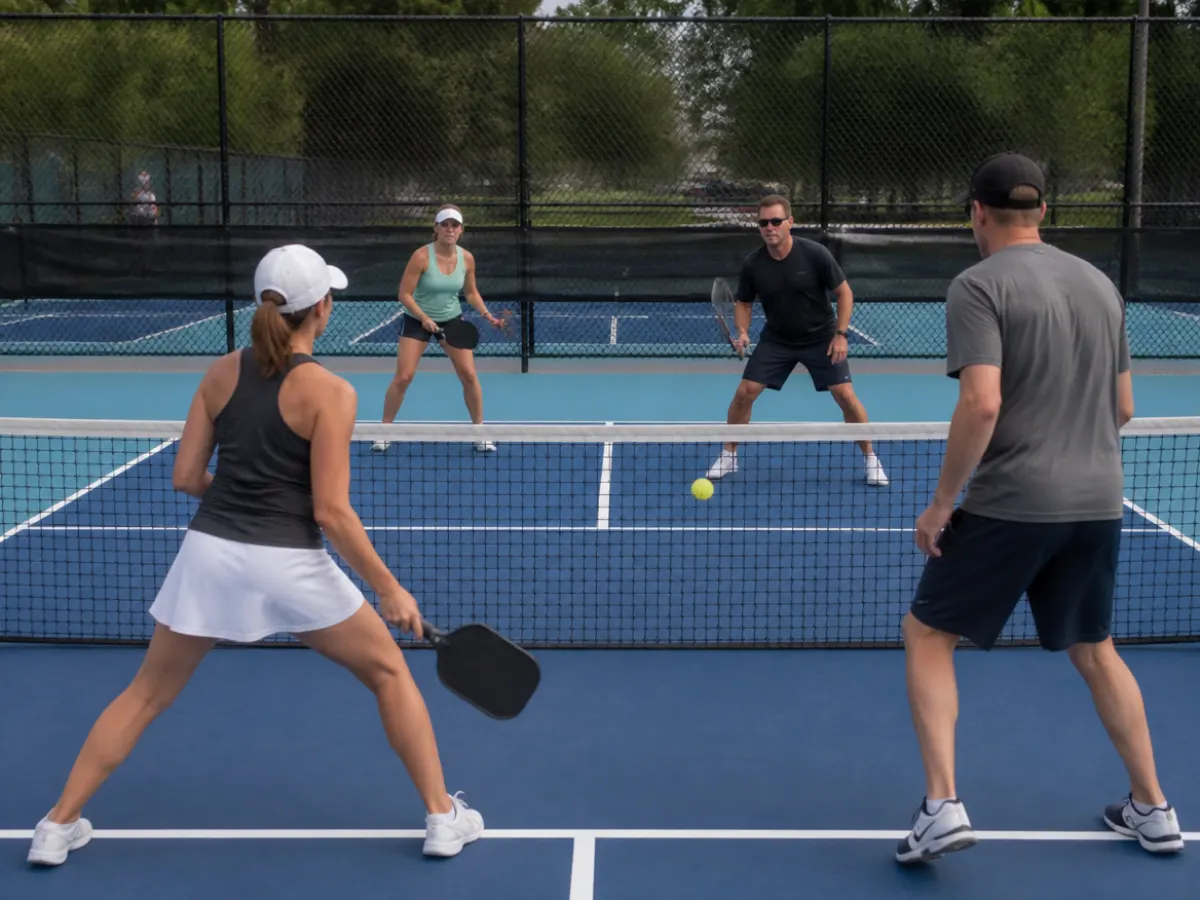
Pickleball has a short rulebook at its core. You serve underhand and crosscourt, let the first two shots bounce, stay out of the 7-foot zone at the net when you volley, and score only when your side serves. Games usually go to 11, and you have to win by 2. Everything else in the rulebook refines those five ideas.
The official rules come from USA Pickleball, the sport's national governing body. It publishes a new edition of the rulebook each year; the 2026 version took effect on January 1, 2026. This guide follows that rulebook and the USA Pickleball rules summary.
Court and equipment basics
A pickleball court is 20 feet wide and 44 feet long for both singles and doubles. The net hangs 36 inches high at the sidelines and 34 inches at the center. On each side, a 7-foot area next to the net is the non-volley zone, which everybody calls the kitchen. You play with a solid paddle and a perforated plastic ball. Our guide to pickleball court dimensions has every measurement.
Pickleball rules for serving
Every rally starts with a serve, and the serve has more rules than any other shot. Here's what applies to every serve:
- At least one foot must be behind the baseline when you hit the ball. Neither foot may touch the court or the baseline, or land outside the imaginary extensions of the sideline and centerline.
- You serve diagonally, into the service court across from you.
- The ball must clear the kitchen. A serve that lands in the kitchen or on the kitchen line is a fault.
- A serve that lands on the sideline, centerline or baseline is in.
- You get one attempt. A serve that clips the net and still lands in the right court is in play, since there have been no let serves since 2021.
- After the score is called, you have 10 seconds to serve.
Volley serve
The classic serve is hit out of the air. Three rules apply: your arm must swing in an upward arc, you must hit the ball below your waist, and the head of the paddle may not be above the highest part of your wrist at contact. You also can't spin the ball with your hand or paddle when you release it.
Drop serve
With a drop serve you let the ball fall from a natural height, let it bounce and then hit it. You can't throw it down or push it toward the court. Because the ball bounces first, the upward-arc and waist rules don't apply, which makes the drop serve easier to keep legal. Many beginners start with it.
The two-bounce rule
The receiving team must let the serve bounce before returning it. Then the serving team must let the return bounce before hitting it. After those two bounces, either side may volley or play the ball off the bounce. This rule keeps the serving team from rushing the net and ending the point on the first shot. Volleying a ball before it has bounced once on each side is a fault.
Pickleball rules about the kitchen
The kitchen, officially the non-volley zone, is the 7-by-20-foot area on each side of the net. It's the rule new players get wrong most often, because it's about volleys and not about where you stand. You may walk into the kitchen whenever you want and hit a ball there after it bounces. These are faults:
- Volleying while you touch the kitchen. The line is part of the kitchen, so a toe on the line counts.
- Volleying and then letting momentum carry you into the kitchen, even if the ball is already dead.
- Your paddle, hat or anything you wear or carry touching the kitchen during a volley.
- Your partner touching you while you volley as they stand in the kitchen.
- Volleying after you were in the kitchen before both feet are back outside it.
Common faults
A fault ends the rally. If the receiving side faults, the serving side gets a point. If the serving side faults, the server loses the serve. Besides the serving, bounce and kitchen faults above, these are the most common:
- Hitting the ball into the net or out of bounds.
- Letting the ball bounce twice on your side before you hit it.
- Touching the net or the net post with your body, clothes or paddle while the ball is in play.
- Getting hit by the ball, or having it hit anything you wear or carry other than your paddle hand below the wrist.
- A ball hitting a permanent object, such as a light pole, before it bounces on the court.
Any ball that touches a line is in, with one exception: a serve that touches the kitchen line is short.
Pickleball scoring in doubles
Traditional pickleball uses side-out scoring, so only the serving team can score. Games go to 11 and must be won by 2. Tournaments sometimes play to 15 or 21.
In doubles, the server calls three numbers before every serve: the serving team's score, the receiving team's score and the server number, 1 or 2. A call of "4-2-1" means your team has 4, the other team has 2 and you are the first server.
- Both partners serve before the ball goes to the other team. When the first server loses the rally, the partner serves as server 2. When server 2 loses a rally, it's a side-out.
- The first serve after every side-out comes from the right-hand court.
- When your team wins a point, the server switches sides with their partner and serves again from the other court.
- The game starts at 0-0-2. The first serving team gets only one server at the start, so the call skips server 1.
What about rally scoring?
In rally scoring, someone scores a point on every rally, no matter who served. The 2026 USA Pickleball rulebook lists it as a provisional rule with a two-number score call, and tournaments can choose it as an option. Recreational play at public courts still almost always uses side-out scoring.
Pickleball rules for singles
Singles uses the same court, serve, bounce and kitchen rules as doubles. Scoring changes in two ways. There is no server number, so the call has two numbers: server score first, receiver score second, starting at 0-0. Your own score tells you where to serve from. With an even score, including zero, you serve from the right. With an odd score, you serve from the left. Lose a rally on your serve and the serve goes straight to your opponent.
Singles takes more running, since you cover the full 20-foot width alone. Most open play at public courts is doubles.
Etiquette at public courts
Busy public courts usually run open play. The details are set by each park or local club, so read the sign at the gate. These customs are common:
- Paddle stack: place your paddle in the rack or on the fence by the entrance. When a court opens, the next four paddles go on together. Some courts use a board with paddle slots for the same job.
- Winners stay or everyone off: courts set their own rotation, often four off after each game when people are waiting.
- Calling lines: you call the lines on your side of the net. If you aren't sure a ball was out, it's in. Call "out" right away.
- Crossing courts: wait until a rally ends before you walk behind a court or chase a ball onto it. Yell "ball on" if your ball rolls into another game, and the point is replayed.
- Mixed levels: many parks post time slots by skill rating. Ask before you join a game above your level.
Find a court to practice on
Our pickleball court finder lists 3,221 parks with pickleball courts across the US, based on OpenStreetMap. The states with the most are Illinois (280), California (243), Minnesota (181) and Michigan (157). Cities with many courts: Minneapolis (41), Saint Paul (32), Seattle (24), Chicago (23), Omaha (23), Salt Lake City (20). If there are no dedicated courts near you, check the tennis courts, since many also carry pickleball lines.
Rules as of the 2026 USA Pickleball rulebook. Local leagues and tournaments can set their own formats.
Sources
- USA Pickleball: Rules summary (serve, two-bounce rule, kitchen, faults, scoring)
- USA Pickleball Official Rulebook 2026 (score calling, 10-second rule, volley and drop serve, provisional rally scoring)
- Selkirk: 2026 USA Pickleball rulebook changes
- Pictona: new pickleball rules for 2021 (end of let serves)