 Outdoors Nearby
Skatepark etiquette for beginners: turns, snaking, helmets and gear
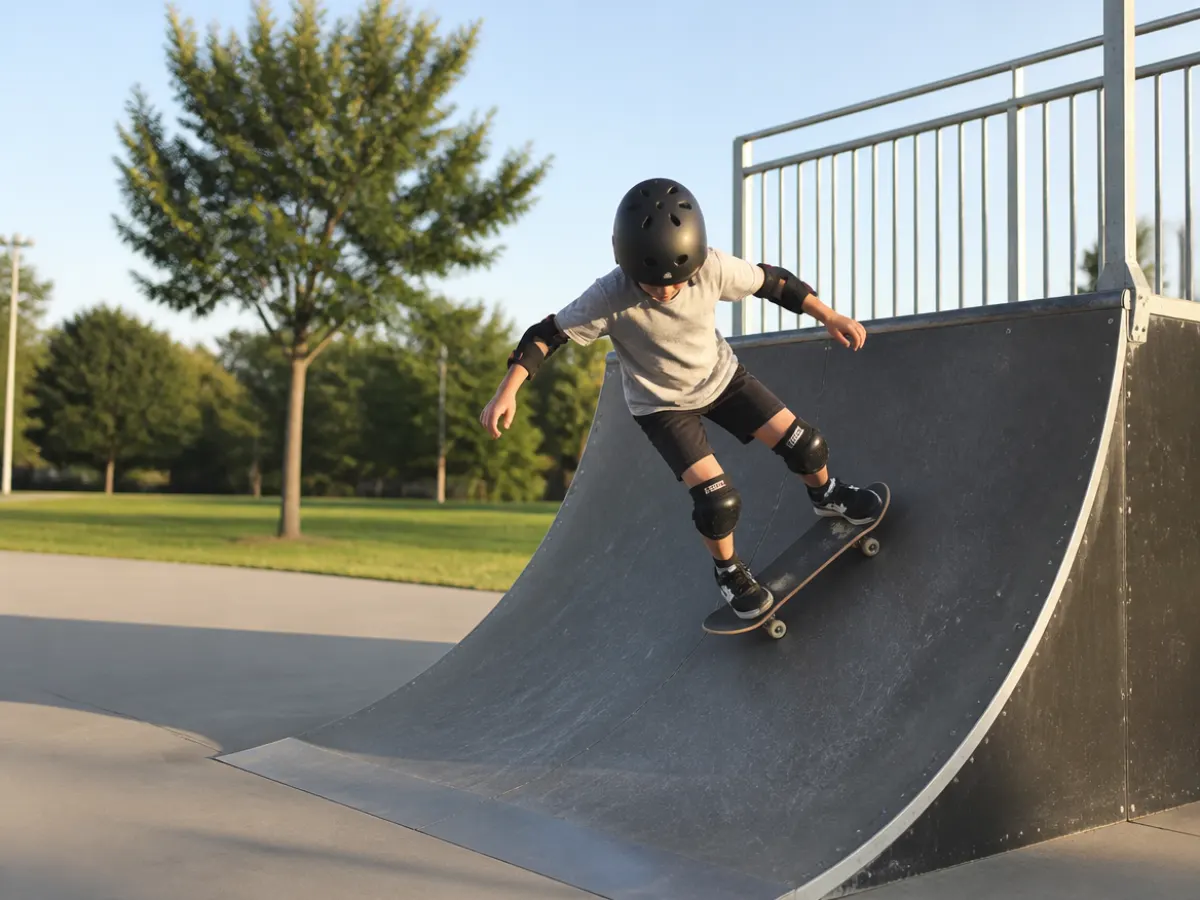
Skatepark etiquette comes down to three habits. Take turns, watch where everyone else is rolling, and keep the obstacles clear. The rules on the sign add the hard limits, usually a helmet, sometimes pads, and often a ban on bikes, scooters or skating when the concrete is wet. Here's how a skatepark works and how to show up as a beginner without getting in anyone's way.
We've mapped 3,718 skateparks across the US from OpenStreetMap. 1,205 are mapped with a concrete surface, and 316 are mapped as lit for evening sessions.
The basic rules of skatepark etiquette
Take turns
At a busy park there's no formal line. Skaters wait on the deck or at the edge of a section and go one at a time. Watch who's been waiting longest, and make eye contact or nod before you drop in so the others know it's your turn. Ann Arbor's skatepark rules put it simply: wait your turn. When your run ends, roll out of the way so the next person can go.
Don't snake
Snaking is dropping in on someone who's in the middle of their run. Two riders end up on the same line, and one of them has to bail. If you do it by accident, get out of the way and apologize. Then wait longer next time.
Watch the flow before you roll
Spend a few minutes at the edge before you skate. You'll see which lines people use, where they land and where they turn around. Don't stop, sit or stand in a landing zone or at the bottom of a ramp. If you fall, grab your board and clear the area right away, because a loose board rolling across the park can take out someone else.
Keep obstacles clear
Ledges, benches and ramps inside a skatepark are part of the course. Ann Arbor's rules ask you to sit outside the park, not on the obstacles, and call standing on the edge of the bowl or half-pipe a big no-no. The same goes for bags, water bottles and phones. Leave them outside the skating area. Tampa bans food and drinks on the skating surface, and glass and gum anywhere in the park.
Skatepark for beginners
Most skateparks aren't built for first-timers, and the AAOS points out that their terrain is often advanced. You can still learn there if you follow a few steps:
- Learn the basics on flat ground first. The AAOS recommends being able to push, slow down, turn and stop before you try anything harder.
- Go when it's quiet. Early mornings and weekdays usually have the fewest people. You get space to fall without blocking anyone.
- Start small. Stay on the flat, a small quarterpipe or a low box at the edge of the park, away from the busy lines.
- Learn to fall. If you lose your balance, crouch down to shorten the fall and try to land on the fleshy parts of your body instead of your arms.
- Ask. Regulars will usually tell you which parts of the park are easiest and when it's quiet.
Kids at the skatepark
The American Academy of Pediatrics, quoted by the AAOS, says children under 5 shouldn't ride skateboards, and kids 6 to 10 need close adult supervision. City rules follow the same idea. Wichita Falls, Texas, admits riders 6 and older and requires an adult over 17 with kids under 10. Tampa requires a parent or guardian with children 10 and under and has parents of riders under 18 sign a waiver.
Do you need a helmet at a skatepark?
In many places, yes. California has the clearest rule. Health and Safety Code section 115800 says the operator of a skatepark may not let anyone ride a skateboard or other wheeled recreational device without a helmet, elbow pads and knee pads. Public parks that aren't supervised meet the rule through a local ordinance and posted signs, and riders who skip the gear can be cited. California's Vehicle Code section 21212 adds that anyone under 18 must wear a helmet on a skateboard, scooter, bike or skates on streets, bikeways and public paths, with a fine of up to $25.
Costa Mesa shows how strictly this can be enforced. Its skatepark requires a helmet, elbow pads and knee pads, violations can be an infraction or a misdemeanor, and anyone convicted three or more times is barred from the city's skateparks for good.
Elsewhere it's up to the city:
- Tampa, Florida: helmet for everyone on the skating surface, elbow and knee pads for skaters under 18.
- Wichita Falls, Texas: helmet required, knee, elbow and wrist pads strongly recommended.
- Ann Arbor, Michigan: helmet, knee pads, elbow pads and wrist guards strongly recommended.
Wear a helmet even where it isn't required. About 70,000 skateboarding injuries end up in US emergency rooms every year, and about half involve kids under 15, according to the AAOS. Wrist fractures are among the most common, and wrist guards reduce how often they happen and how bad they are.
Scooters, BMX bikes and skates
Every park sets its own list of what can ride. Costa Mesa allows skateboards and roller skates only, so no bikes or scooters. Ann Arbor bans bicycles. Tampa bans BMX bikes. Wichita Falls allows skateboards, inline skates and BMX bikes without pegs. Read the sign at the entrance before you unload your bike or scooter. Where everyone shares the park, the same etiquette applies to all of them. Wait your turn, don't snake, and keep the landings clear.
Rain and wet concrete
Don't skate a wet park. Wet concrete and wet wheels lose grip without warning. Tampa says its skatepark doesn't operate when the surface is wet, and Wichita Falls bans skating and biking when the surface is wet, when it's raining and during lightning. The AAOS also advises skipping wet and icy surfaces and checking for cracks, rocks and debris before you ride. After a storm, wait until the bowl and the transitions are fully dry, since water collects at the bottom.
What to bring to the skatepark
- A helmet that fits, worn every time.
- Knee pads, elbow pads and wrist guards. Pads are required in California and at Tampa for riders under 18.
- Closed-toe shoes with grippy, slip-resistant soles.
- Water, kept outside the skating area.
- A signed waiver, if your park requires one for minors, as Tampa does.
The AAOS also suggests a shorter deck for beginners, because it's easier to balance and control.
Find a skatepark near you
Our skatepark map covers all 50 states. The states with the most mapped skateparks are California (553), Texas (205), Washington (202) and Illinois (165). Cities with many: Los Angeles (40), Seattle (26), Brooklyn (22), Portland (22), San Diego (20), Minneapolis (20).
Data from OpenStreetMap. Rules and hours change, so read the sign at the park and check your city's website.