 Outdoors Nearby
Dog park etiquette: the rules, the first visit and what to bring
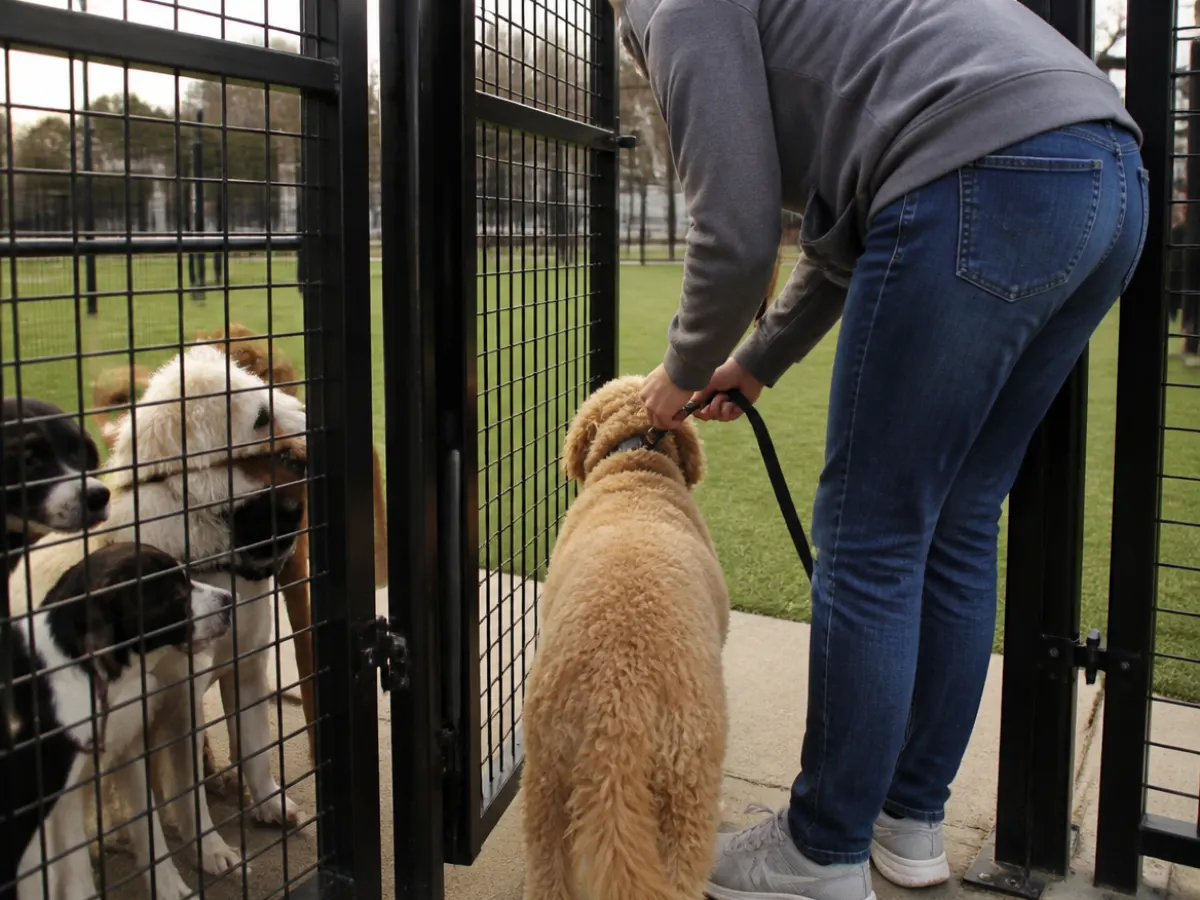
Most US dog parks post the same core rules. Your dog needs a current rabies vaccination and license, puppies under 4 months and females in heat stay home, dogs are leashed at the gate, and you pick up after your dog. Cities add their own rules on top, such as Denver's two-dog limit or Chicago's $10 permit tag. Below you'll find what the signs say, how to tell if your dog is ready, and what to pack.
We've mapped 4,835 dog parks across the US from OpenStreetMap. 847 are mapped as fenced, and 488 have more than one dog area, often split into sections for small and large dogs.
Dog park rules and regulations you'll see on the sign
Vaccinations and license
Rabies is required everywhere, and most cities want the tag on the collar. Houston asks for a current city license plus the rabies tag. Some cities go further:
- Chicago: rabies plus distemper, hepatitis, parainfluenza, parvo, bordetella and lepto, and a negative fecal parasite test. You also need a Dog Friendly Area permit and tag ($10 total). Using the area without one can cost $500.
- Charlotte (Mecklenburg County): current rabies, DHLPP and Bordetella.
- Madison, Wisconsin: a city dog license plus a park dog permit, $8 a day or $46 a year.
- Boston: a city license for dogs over 6 months, $15 if spayed or neutered and $30 if not.
The AKC also recommends shots against bordetella, leptospirosis and canine influenza, plus flea, tick and heartworm prevention. Miami-Dade bans dogs with fleas, ticks or worms outright.
Puppies, females in heat and intact dogs
The usual minimum age is 4 months. Chicago, Houston, Seattle, San Francisco, Miami-Dade, Nashville and Raleigh all use it, and Atlanta says 16 weeks. Austin bans dogs too young for a rabies shot. The AKC says puppies under 4 months without all their vaccinations should stay out, and the AVMA has warned vets that a dog park is not puppy kindergarten.
Females in heat are banned in nearly every city with posted rules. A few cities also want dogs fixed. Austin's off-leash areas, Dallas and Los Angeles require spayed or neutered dogs, and Denver accepts an intact dog only with a Denver Intact Permit.
Leash in, leash out, and the double gate
Keep the leash on until you're inside and clip it back on before you leave. Chicago, Houston, San Francisco and Dallas all spell this out. Most fenced parks have a double gate, a small pen between two doors. Walk in, close the outer gate behind you, unclip the leash, then open the inner gate. Raleigh only allows unleashing inside that entry pen, and Atlanta asks you to close and latch both gates.
If a group of dogs rushes the gate when you arrive, wait for them to drift off before you go in. The AKC flags a crowded entrance as a common trigger for scuffles. Several cities, including Raleigh, Austin, Dallas, Kansas City and Seattle, also ask you to take off prong, choke and spiked collars before entering.
Dogs per handler and age limits for people
| City | Dogs per person | Children |
|---|---|---|
| Denver, CO | 2 (handler 16+) | 10 and under not allowed; 11 to 15 with an adult |
| Houston, TX | 2 | 12 and under not allowed; 13 to 18 with an adult |
| Nashville, TN | 2 | Under 10 not allowed in the fenced area |
| Chicago, IL | 3 | Under 12 with an adult |
| Austin, TX | 3 off leash | Under 12 with an adult |
| Kansas City, MO | 4 (adult 16+) | 8 and under not allowed; 9 to 15 with an adult |
Waste and holes
Pick up right away. Chicago fines up to $500 for leaving waste, and Washington, DC, fines $150 to $2,000. San Francisco, Austin, Tampa and Miami-Dade also ask you to fill any holes your dog digs.
Food, treats and toys
This is the rule that varies most. Chicago bans human and dog food inside the area. Raleigh bans food, treats and toys, and San Antonio asks you to leave all three at home. Denver allows dog treats but no human food, and Atlanta allows only bite-size dog treats. The AKC's advice is to leave toys at home, tennis balls too, and to put any toy away the moment another dog arrives.
Small dog areas
Many parks have a separate small-dog side. Portland bars dogs 19 inches or taller from its small-dog-only areas. The AKC asks you to keep big dogs out of the small area, and the reverse, especially when the park is busy.
Is my dog ready for the dog park?
Run through this list before your first visit:
- Your dog is at least 4 months old, fully vaccinated and healthy.
- It comes back when called. Seattle, Portland and Tucson require dogs to be under voice control off leash.
- It enjoys other dogs and isn't fearful around them. The AVMA notes that aggressive or fearful dogs generally don't belong in a dog park.
- It doesn't guard balls, sticks or water bowls. The AKC names resource guarding as a sign a dog may struggle there.
If your dog fails one of these, work on it with a trainer or with one calm dog first.
Your first visit
Go at a quiet time, such as a weekday morning. Watch the park from outside the fence for a few minutes before you go in, and skip it if it's packed. Keep the first visit short. The AKC says 30 minutes is plenty of play. Stay off your phone and keep your eyes on your dog, because owners who ignore their dogs are one of the warning signs the AKC lists. Leave a high-value treat in the car to reward your dog for coming with you when it's time to go.
Body language and when to leave
Good play looks loose and bouncy. Dogs start with a play bow, move in a wiggly way with short pauses, and keep their mouths open and eyes soft, according to the ASPCA. Step in or leave when you see any of these:
- Other dogs keep rolling your dog or chase it without letting up.
- Your dog hides behind your legs or waits by the gate.
- A stiff body, raised hackles, hard eyes with the whites showing, a tucked tail or growling.
- The park fills up and play gets rough.
A dog that keeps moving away, sniffs the ground or lies down is often telling the other dog that play is over.
If your own dog is the problem, leash it and go. Houston, San Antonio and Tucson all require you to remove a dog at the first sign of aggression. The AKC suggests a short apology to the other owner and no punishment for your dog.
Hot and cold weather
Dogs run hard at the park and overheat fast. The ASPCA warns against letting dogs linger on asphalt, sand or other hot surfaces, which can burn paw pads, and asks owners to make sure there's water and shade. Signs of heatstroke include heavy panting, drooling, weakness and collapse, and a body temperature above 104°F is an emergency. Bring your own water and bowl. Communal bowls can spread germs, and Madison doesn't allow shared bowls to be left out.
In winter, wipe your dog's paws and belly after the visit to remove ice, salt and de-icing chemicals, and check the pads for cracks. The ASPCA suggests a coat for short-haired dogs.
What to bring to a dog park
- A leash for each dog. Austin wants one leash of 6 feet or less per dog, and Seattle wants you to carry one per dog.
- A flat collar or harness with the license and rabies tags.
- Your permit, if your city requires one (Chicago, Madison).
- Poop bags. Saint Paul asks you to bring your own.
- Water and a bowl, plus a towel for muddy or salty paws.
- Treats, left in the car unless the rules allow them.
Leave toys, food, bikes and lawn chairs at home. Seattle asks you to leave bikes outside, and Raleigh bans outside furniture.
Find a dog park near you
Our dog park map covers all 50 states. The states with the most mapped dog parks are California (567), Texas (342), Florida (314) and New York (223). Cities with many: Chicago (41), Portland (40), Austin (38), Houston (34), San Francisco (33), Denver (31).
Data from OpenStreetMap. Rules change, so read the sign at the gate and check your city's parks page.
Sources
- AKC: Dog park safety tips and AKC Reunite: Dog park etiquette
- AVMA: Advising clients about dog parks
- ASPCA: Hot weather tips, cold weather tips and canine body language
- Chicago, Denver, Houston, Austin, Dallas, San Antonio, Raleigh, Mecklenburg County, Atlanta, Nashville, Kansas City
- San Francisco, Los Angeles, Seattle, Portland, Tucson, Tampa, Miami-Dade, Saint Paul, Madison, Boston, Washington, DC